-
E-mail : info@sparktechclean.com


E-mail : info@sparktechclean.com
In factories, warehouses, shopping malls, and other large facilities, sweepers and scrubber dryers are the workhorses of floor cleaning. But they are not interchangeable: sweepers are designed for dry debris, while scrubber dryers handle wet stains and deep cleaning. Choosing the wrong machine wastes time and money – and leaves the floor either dusty or slippery.
| Industrial Sweeper | Industrial Scrubber Dryer | |
|---|---|---|
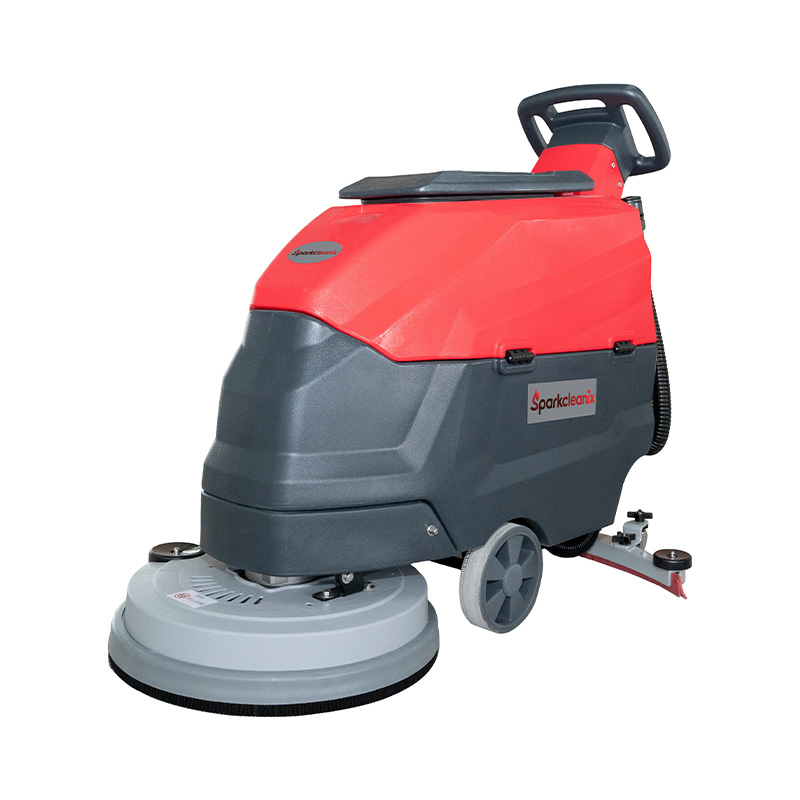
| How it works | Side brushes + main brush sweep dry waste into a hopper; vacuum and water mist optional for dust control | Sprays water/detergent, scrubs with a brush, vacuums up dirty water, and leaves the floor dry in one pass |
| Best for | Dry waste: dust, gravel, sand, leaves, metal chips, paper scraps | Stubborn stains: oil, tyre marks, chemical residues, water puddles |
| Floor types | Rough or hard surfaces: concrete, asphalt, diamond‑grid floors | Smooth, hard surfaces: epoxy, tiles, marble, PVC, polished concrete |
| Typical settings | Outdoor roads, logistics aisles, machine shops, dry parking lots | Food/electronics workshops, underground garages, mall lobbies, hospitals, airports |
| Result | Basic sweeping with controlled dust | Deep cleaning – floor is washed and dried instantly, no slippery residue |
Outdoor open areas (factory roads, plazas, parks) → Sweeper. Surfaces are concrete/asphalt; waste is mainly leaves, dirt, and gravel. Sweepers cover large areas fast and handle rough ground well.
Indoor workshops with heavy oil/grease (machine shops, food processing) → Scrubber dryer. Oil and chemical residues require scrubbing and suction – sweepers cannot remove them.
Warehouses and underground garages – it depends:
Mostly dust and cardboard debris → sweeper.
Tyre marks, oil spots, or standing water → scrubber dryer.
For mixed conditions, using both in sequence is most effective.
Commercial spaces (shopping malls, hotels, office lobbies) → Scrubber dryer. Tile or marble floors need a polished, spotless look. The “scrub‑and‑dry” function prevents slips in pedestrian‑heavy areas, and the machines produce less dust and noise.
Schools, hospitals, airport terminals → Scrubber dryer. High hygiene standards require deep cleaning and immediate drying – sweepers alone cannot meet these requirements.
Is your waste dry or wet?
Dry → sweeper. Wet / oily → scrubber dryer.
Is your floor smooth or rough?
Smooth (tile, epoxy) → scrubber dryer. Rough (concrete, asphalt) → sweeper.
Do you need “swept clean” or “shiny clean”?
Basic cleanliness → sweeper. Deep shine and hygiene → scrubber dryer.
For areas with both dry and wet dirt (e.g., logistics corridors), schedule the sweeper first to remove dry debris, then follow with the scrubber dryer for a thorough wash – each does what it does best. For areas under 3,000 m², walk‑behind machines are cost‑effective; above 5,000 m², ride‑on models boost productivity. Choose wisely, and your floors will stay safe, clean, and long‑lasting.
Tel : +86-19105657103
Email : info@sparktechclean.com